Saturday, February 20, 2010

Martin Luther King and the Possibility of Change

"Let us not wallow in the valley of despair, I say to you today, my friends.
And so even though we face the difficulties of today and tomorrow, I still have a dream. It is a dream deeply rooted in the American dream."

I have friends who don’t believe in change.

They insist that no matter how hard we try, no matter what we do, things won’t get better. They tell me “the man” has too much power, and nothing we do can ever make things right. They don’t believe we can overthrow the fossil fuel dinosaurs of oil and coal in order to move forward with renewable green energy. They don’t believe we can stop the bleeding in habitats across our country and across the globe; stop the bleeding and start the healing.

But I know that’s not true. I’ve seen it with my own eyes.

Barely a year ago, I saw a Black man take the oath of office. Who would have believed that would ever be possible?

We cannot walk alone.
And as we walk, we must make the pledge that we shall always march ahead.
We cannot turn back.

Let me tell you a little family history, by way of illustration.

My grandfather was born in Poland; as a poor immigrant he put himself through medical school. But he went into private practice, because when he graduated in 1929 there wasn’t a hospital in Toronto that would take a Jew on staff.

Don’t tell me things can’t change.

My mother went to one of the best high schools in Toronto, Harbord Collegiate. She probably could have become a doctor, too - hell, she was the top student in her class; she could have been ANYTHING. But when she met with her vocational counselor, he took a look at her outstanding record and told her “You’re very precise. You’ll probably make a wonderful clerical worker.” In those days, women didn’t become doctors or lawyers or corporation presidents.

Don’t tell me things can’t change.

When Barack Obama was born in 1961, his prospects were even worse than my mothers. She was a woman, and a Jew, but at least she was white. Black men didn’t become doctors or lawyers. Black men were called “Boy” even when they had grey beards. Black men couldn’t eat at lunch counters or piss in public restrooms or stay in hotels. Black men who spoke up or talked back or didn’t know their place were regularly lynched across the South and even in the North – hunted down like animals by angry mobs and hanged or shot or worse.

Don’t tell me things can’t change.

You now that’s not true. You’ve seen it with your own eyes.

I have a dream - that one day on the red hills of Georgia, the sons of former slaves and the sons of former slave owners will be able to sit down together at the table of brotherhood.

Twenty years ago I, as a young reporter, saw Jesse Jackson speak at the Democratic National Convention in Atlanta, and marveled that this was even possible. In what had only a few years before been the heart of segregation country, this man – this Black man - electrified the nation. Everyone knew he could never be elected President, of course, but it was amazing that he had run a serious campaign and earned millions of votes.

Watching that speech, I never dreamed that in just 5 election cycles, I’d be watching a Black man take the oath of office as the 44th President of the United States.

I have a dream - that my four little children will one day live in a nation where they will not be judged by the color of their skin but by the content of their character.

Jesse Jackson lost the nomination to Michael Dukakis, of course, who proceeded to get his ass handed to him by the first George Bush. A bully and an oilman, Bush won that election by ridiculing his opponent, just as he ridiculed his next opponents four years later as “Bozo and Ozone Man”. Yes, that’s what he called Bill Clinton and Al Gore; laughing at them for caring about the planet. But this time he got HIS ass handed to him.

“First they ignore you, then they laugh at you, then they fight you, then you win.” – Mahatma Ghandi.

They ignored us and continued pumping their oil and digging their coal. Then they laughed at us – called us “Ozone Man” and “Treehugger” and “Dirty Hippie”.

Now they are fighting us. But the tide has turned.

We have also come to this hallowed spot to remind America of the fierce urgency of Now… It would be fatal for the nation to overlook the urgency of the moment.

First they ignore you, then they laugh at you, then they fight you, then you win.
Change happens because we will it. Change happens because we make it happen. Inch by inch, heart by heart and mind by mind.

Don’t just sit there - do something! Go the the Martin Luther King Jr Day of Service website and find volunteer opportunities in your neighborhood that you could be doing right now!

And if you do, post a comment here and tell us what you did.

(Originally appeared at TenthMil.com)

Tuesday, February 02, 2010

Obama Budget Cuts Oil Money, Adds Renewables

After criticism for not talking enough about renewables in his SOTU speech, President Obama’s new budget shows us the money - according to a White House statement, more than $6 billion. But is it enough? You’d think that with a total of $3.8 trillion on the table, a few more crumbs could have been tossed toward energy - and planetary - security.

“The President’s budget cuts wasteful spending while making wise investments in innovation and clean energy that will put Americans back to work, save families money and keep our nation competitive in the global marketplace,” said Energy Secretary Steven Chu. “This budget supports new approaches to energy research and invests in the next generation of scientists and engineers, and it will spark new clean energy projects nationwide, including restarting the American nuclear power industry.”

“America must move to a clean-energy economy,” Interior Secretary Ken Salazar said. “We believe that the taxpayers should receive a fair return on the resources that belong to them.”

The DOE reports the good news on the fossil fuel front, as the new budget cuts the following:
* Eliminating more than $2.7 billion in tax subsidies for oil, coal and gas industries. This step is estimated to generate more than $38.8 billion dollars in revenue for the federal government over the course of the next 10 years.
* Another $8.5 billion would come in by cutting a tax break oil and gas companies currently get for taxes paid oversees.
* Terminating Ultra-Deepwater exploration program, saving $50 million.
* Canceling planned expansion of the Strategic Petroleum Reserve, saving $71 million.
* There’s also a new fee on “non-producing” leases - a modest $4 an acre that would encourage companies are currently sitting on leases without doing any drilling or exploration (even while they try to get more and more areas opened up for leasing) to start doing something with them. That is estimated to bring in $1.15 billion.

There is also word that $2.3 billion in tax breaks for coal will be cut over 10 years as well.

And for green energy:
* More than $217 million in new funding for science research and discovery, including an additional $40 million for the existing Energy Frontier Research Centers program and $107 million for Energy Innovation Hubs.
* $300 million for the Advanced Research Project Agency – Energy (ARPA-E);
* Lending authority to support approximately $40 billion in loan guarantees for innovative clean energy programs. (But $36 billion of that is an increase in guarantees for new puclear plants)
* More than $108 million in new funding to advance and expand research in the areas of wind, solar and geothermal energies.
* $43 to the EPA for greenhouse gas reduction under the Clean Air Act
* There are also millions more in funds for water cleanup, including $300 million to restore the Great Lakes (we’ll be writing more about this)

Energy Boom breaks out some more numbers:

$4.7 billion in clean energy technology investments at DOE, including:
* Nearly $2.4 billion, an increase of $113 million, for energy efficiency and renewable energy programs including $302 million for solar energy, $220 million for biofuels and biomass R&D, $325 million for advanced vehicle technologies, and $231 million for energy efficient building technologies.
* $545 million for advanced coal climate change technologies to focus resources to develop carbon capture technologies with broad applications to advanced coal power systems, existing power plants, and industrial sources.
* $300 million for the Advanced Research Projects Agency–Energy to accelerate game-changing energy technologies in need of rapid and flexible experimentation or engineering.
* $793 million for clean energy activities and civilian nuclear energy programs, including research and development and infrastructure programs. The budget includes a new cross-cutting research program to address technology needs for all aspects of nuclear energy production.


And as Josie Garthwaite at Green2Tech notes,

Makers of green energy equipment could also benefit under a proposed $5 billion expansion of a tax credit first created as part the stimulus package, which covers up to 30 percent of the costs for new, expanded or retooled greentech equipment factories. That likely comes as welcome news for the companies behind several hundred projects that didn’t make the cut for $2.3 billion in credits awarded last month under the oversubscribed program.

Garthwaite also points to something missing from this budget: revenue from carbon allowances, “signaling dwindling confidence that the Senate will pass a bill with a cap and trade system this year.”

But President Obama doesn’t appear ready to throw in the towel on that one yet. In a press conference, he said “Because our future depends on our ability to break free from oil that’s controlled by foreign dictators, we need to make clean, renewable energy into a profitable kind of energy. That’s why we’ll be working with Congress on legislation that places a market-based cap on carbon pollution and drives the production of more renewable energy.”

You can get the DOE budget here or the Federal Budget here if you want that level of detail.

Do Something Now!

If you want a quick way to get involved, write to your Senator/Congressperson and tell them you support increased money for green energy.

Drop a note to President Obama thanking him for supporting renewables.

(Originally appeared at TenthMil.com)

Saturday, January 30, 2010

Take Your Algae Biofuel News With a Grain of Salt

A study released this week says Algae fuels may not be worth it. But critics point out that the study’s data were old – some more than ten years old.

It’s a picture-perfect example of how when it comes to arguments over renewable energy, it’s always good to check your sources.

The Study

Bearing the difficult title “Environmental Life Cycle Comparison of Algae to Other Bioenergy Feedstocks”, the study concluded that Algae for biofuel isn’t as good for the environment as other potential fuel-crops such as switchgrass, canola and corn.

(“What’s that?” you say. “Isn’t corn ethanol bad?” Keep reading…)

One of the study’s lead authors was Andres Clarens, an assistant professor of civil engineering at the Civil and Environmental Engineering Department of the University of Virginia. The New York Times had him explain his findings:

The main reason for this is that fertilizers have to be directly delivered to the pool of water that algae is growing in… And fertilizers are very energy intensive to produce.
Corn and switchgrass can draw nitrogen from soil, which reduces the overall amount of fertilizer required, he said. In addition, crop rotation can help replenish soil nutrients.
“Nutrients are going to be the limiting factor,” Dr. Clarens said. “We’re humans. We need to eat dinner, and you can’t expect to have algae that provides a bunch of energy without feeding it nutrients.”

And it’s true that fertilizers – mostly petrochemical-based – have a nasty carbon footprint. That’s why, for instance, corn-based biofuels have turned out to be such a carbon disaster. But… algae?

Critics cry “Foul!”

The Algal Biomass Assocation responded,

“...We expect such research to be based on current information, valid assumptions and proven facts. Unfortunately, this report falls short of those standards with its use of decades old data and errant assumptions of current production and refining technologies.”

Where’s the issue? Older studies did indeed use fertilizers, but these were small-scale pilot projects. Current plans for large-scale operations call for using wastewater, which is full of nutrients, instead of taking clean water and adding nutrients.

Riggs Eckelberry, chief executive of the algae biofuel company Origin Oil, told The New York Times,

“Identifying wastewater is a homerun for algae production, probably the best there is,” he said. “There are lots of nitrates, and algae love dirty water — they can remove toxins, such as medical drugs from that water.”

And it gets even better: energy is currently used treating wastewater, so using it to grow algae saves that CO2 as well.

The Happy Ending

The authors of the study complained that many of today’s algae companies use proprietary processes – they say that with everybody keeping trade secrets, they shouldn’t be blamed for using ancient data (and in the algae field, 10 years back is practically the dark ages).

It appears Mary Rosenthal of the Algal Biomass Association is talking with Clarens about cooperating on a follow-up study. That should make everybody happy - and provide everyone with accurate and up-to-date science.

(Originally appeared at Tenthmil.com)

Friday, January 29, 2010

Is There an Alternative to Storing Nuclear Waste in Your Backyard?

What’s going on with Nuclear Energy?

Energy Secretary Steven Chu announced a new panel this morning to take a microscope to the future of nuclear power in America. The bi-partisan group will be headed by Lee Hamilton (a Democrat with ties to the intelligence community) and Brent Scowcroft (a Republican with ties to the intelligence community).

From the announcement:

In light of the Administration’s decision not to proceed with the Yucca Mountain nuclear waste repository, President Obama has directed Secretary Chu to establish the Commission to conduct a comprehensive review of policies for managing the back end of the nuclear fuel cycle. The Commission will provide advice and make recommendations on issues including alternatives for the storage, processing, and disposal of civilian and defense spent nuclear fuel and nuclear waste.

For those of you not familiar with their backgrounds, Hamilton was a long-time Democratic Congressman from Indiana, chaired the House Intelligence Committee, and then served on both the 9/11 Commission and the Iraq Study Group. Scowcroft was the National Security Advisor to both Gerald Ford and Bush I but broke with Bush II over the Iraq war, which he publicly advised against (“Don’t Attack Saddam”, WSJ).

What was wrong with Yucca Mountain? Well, it turned out that the proposed storage facility was in someone’s back yard! And that someone was Senate Majority Leader Harry Reid (D-Yucca Mountain). Which bodes ill for the fate of the Hamilton/Scowcroft commission. The bottom line on nuclear waste: nobody wants it in their back yard.

Obama’s line about more nukes in his State of the Union got the lowest grade of the entire speech in MoveOn.org’s membership focus group (see our SOTU wrapup article). While there are definitely voices promoting nuclear power, they’re few and far between on the progressive side of politics, where it seems nobody really wants to promote nuclear energy.

(Originally appeared at TenthMil.com)

Thursday, January 28, 2010

Red State, Blue State, State of the Union

Okay. President Obama talked about jobs, about energy, about jobs, about climate, and about jobs. Did we mention jobs?

As President, it’s not his job to make everybody happy. But it helps if he wins over more than 51 percent.

Some folks were definitely happy. Steven Cohen, Executive Director of the Earth Institute at Columbia University, wrote at the Huffington Post:

I continue to root for Barack Obama. Blunt and tough was just the right tone for his first State of the Union. While I expected him to submerge climate policy within the veneer of energy and employment policy, I was impressed that he addressed it so directly

So was “billyparish”, writing at Its Getting Hot In Here:

But from the standpoint of an aspiring green entrepreneur, there was an awful lot to like in the speech. This was the jobs speech it needed to be, and it continued what may be the overarching theme of his presidency, “to lay a new foundation for long-term economic growth.” ...But more than any speech we’ve heard from him before, he put clean energy jobs at the absolute center of his job creation strategy, mentioning clean energy 10 times, solar twice and climate change 3 times. His discussion of U.S. competitiveness in the global economy is entirely framed in the context of the race to develop clean energy technologies.

And Frances Beinecke, president of the Natural Resources Defense Council, was more than pleased:

President Obama issued a clear and unmistakable call to action tonight, charging the Senate to pass the comprehensive clean energy and climate legislation we need to put Americans back to work and lay the foundation for a generation of prosperity, efficiency and security.
The President could not have been more clear: This legislation will jump-start economic growth, reduce our reliance on foreign oil and roll back the pollution that threatens our future. The Senate should pass it without delay.
The President is right on the money. His plan will get Americans back on their feet. Now it’s our job to let our Senators know where we stand. This is our moment. This is our charge, too. It’s time to pass comprehensive clean energy and climate legislation and put America back to work.

It looks like he did well overall. A CBS News poll found 83% of speech watchers approved of Obama’s proposals, although his harshest critics on the right probably weren’t watching to hear some of the olive branches he offered them.

And those olive branches didn’t exactly enamor some of the doves of the left. Progressive organization MovOn.org ran a mega-focus group – more than 10,000 MoveOn members in a real-time “dial test”, providing instant feedback that allowed them to create a moment-by-moment reaction roadmap throughout the speech.

The lowest-rated phrase in Obama’s SOTU? Not too surprising:

That means building a new generation of safe, clean nuclear power plants in this country. It means making tough decisions about opening new offshore areas for oil and gas development.

This phrase got a better reaction (although Republican legislators laughed out loud at “overwhelming”):

I know that there are those who disagree with the overwhelming scientific evidence on climate change,” he said. “But even if you doubt the evidence, providing incentives for energy efficiency and clean energy are the right thing to do for our future.

Some who have been fighting for clean energy were disappointed at the President’s version of “clean energy”. Like David Roberts at Grist:

...what [“clean energy”] means was, in order: nukes, offshore oil and gas drilling, biofuels, “clean coal,” and ... well, that’s it. That’s right, in listing what “clean energy” means the president did not mention renewable energy. That’s just stunning. It’s 2010 and renewable energy isn’t even an afterthought? Seriously?

Or the Get Energy Smart Now blog, which drew a sharp contrast between SOTU 2009 and SOTU 2010:

In 2009, President Obama made a strong and uncompromising call for investments in “clean, renewable energy” and made a direct statement about the type of climate legislation expected from Congress (”market-based cap on carbon pollution”). He provided a meaningful opening target: “we will double this nation’s supply of renewable energy in the next three years”.
In 2010, President Obama did not even mention the word “renewable”, failed to refer back to the strong statements about renewable energy in the 2009 SOTU and how we on track to achieving (and likely exceeding) them, and sounded like he could have been speaking to the Republican National Convention in the Luntz-ian like redefinition of a “clean energy economy”...

What was Obama thinking, calling for more nukes? He’s probably thinking of Senators John Kerry (D-MA), Joe Lieberman (LIE-CT) and Lindsey Graham (R-SC) who are trying to put together a bi-partisan climate bill. Whether or not he won any hearts and minds on the other side of the aisle, he didn’t endear himself to his supporters.

As commenter “shiplord kirel” offered over at rightwing blog Little Green Footballs:

With the kind words for coal and nuclear, O has grabbed his last few far-left supporters by the scruff of their scruffy necks and tossed them right under the bus of state.

Obama also may have been pitching to those notorious “swing voters” that everyone has been so concerned with. Democracy Corps did a focus group of swing voters, and found that their approval of the President jumped from 44 percent pre-speech to 60 percent after.

They didn’t ask about green initiatives specifically, so we don’t know the group’s reaction on that front (although his “Tax the Banks” plan was wildly popular.)

But we do know one thing: Swing voters liked what they heard, but have doubts as to whether he can deliver.

Unlike most attributes that shifted during the speech, “promises things that sound good but won’t be able get them done” remained very high (78 percent pre-speech to 74 percent post-speech). The “shifters” in these post-speech focus groups are waiting for results, and they pointed specifically to passing health care reform and job creation initiatives as critical reforms that must be delivered. While they see the Republicans as obstructing every Obama initiative, they nonetheless expect Democrats to pass major legislation with their large majorities.

One final poll number: last week Republican Pollster and media guru Frank Luntz reportedon a national survey with some encouraging results:

• 57 percent agreed with the statement: It doesn’t matter if there is or isn’t climate change. It is still in America’s best interest to develop new sources of energy that are clean, reliable, efficient and safe.
• National security is the main reason that people support cap and trade. Across the demographic board, people liked the idea that clean energy will liberate us from this oil addiction.

You want bi-partisan? It sounds like there’s already a bi-partisan consensus in this country. We just have to wait for our politicians to tap into it.

(Originally appeared at TenthMil.com)

Wednesday, January 27, 2010

Putting a Price on Nature

There’s a beautiful meadow up by Bend, Oregon, at the heart of the Glaze Meadow restoration project. The TENTHMIL team was up there with a film crew last year, and I was asked, “Looking out over this meadow, what would you say to the people back in the city?”

And I said, “It’s really sad that the only way this land would have any ‘value’ would be if we put a strip mall on it.”

Nature isn’t free, but a lot of people do business as if it is – and this has been going on for thousands of years. It’s called “The Tragedy of the Commons”, and it warps our economic decisions in all kinds of ways.

Economists are finally coming around to that point of view, as reported this month in The Economist.

A number of the thinkers who have made it a hot topic in the past decade gathered at a meeting on biodiversity and ecosystem services held by the Royal Society, in London, on January 13th and 14th. They looked at the progress and prospects of their attempts to argue for the preservation of nature by better capturing the value of the things – such as pollination, air quality and carbon storage – that it seemingly does for free.

They take a look at the example of a mangrove swamp. Worthless land, right? Nobody would want to own a mangrove swamp. Recently, governments in southeast Asia have been subsidizing shrimp farming, in order to take advantage of that useless, wasted land.

Oops.

In 2007 an economic study of such shrimp farms in Thailand showed that the commercial profits per hectare were $9,632. If that were the only factor, conversion would seem an excellent idea.
However, proper accounting shows that for each hectare government subsidies formed $8,412 of this figure and there were costs, too: $1,000 for pollution and $12,392 for losses to ecosystem services. These comprised damage to the supply of foods and medicines that people had taken from the forest, the loss of habitats for fish, and less buffering against storms. And because a given shrimp farm only stays productive for three or four years, there was the additional cost of restoring them afterwards: if you do so with mangroves themselves, add another $9,318 per hectare. The overall lesson is that what looks beneficial only does so because the profits are retained by the private sector, while the problems are spread out across society at large, appearing on no specific balance sheet.

Swamps aren’t the only places this is starting to get noticed. From forests that don’t look like they provide services until they’re cut down and water quality goes to hell downstream, to swamps that prevent expensive flooding when storms hit, there’s a new school of economics that evaluates the true costs of environmental problems and helps governments make more rational, cost-effective decisions.

One such group is the Natural Capital Project, based at California’s Stanford University, whose InVEST computer program is helping governments in Tanzania and Columbia analyze real costs.

The Economist notes that not everyone agrees with this newfound crossing of balance sheets with bio-inventories.

Some think the notion is an affront to those who place cultural, spiritual or aesthetic value on biodiversity for its own sake. It would be a mistake to look at things this way. In valuing a particular service – such as the cost of erosion to Greek hillsides – which can be quantified with a reasonable degree of certainty, you do not exhaust the reasons for preserving the groves where the dryads play.

“...We can never do nothing. That which we have done for thousands of years is also action. It also produces evils.”
- Garrett Hardin, “The Tragedy of the Commons”


(Originally appeared at TenthMil.com)

DOE Takes Baby Steps on Geothermal and Earthquakes

What’s the real scoop on Geothermal and earthquakes? Despite a NY Times report that has been picked up by other outlets, (for instance, here and here), the Department of Energy (DOE) is not initiating any major new regulations for Geothermal projects.

What they have done: building on the experience at The Geysers geothermal field in California, they are issuing a new policy that will apply to “all new Enhanced Geothermal [Systems (EGS)] projects, including those recently funded through the Recovery Act.” The Obama Administration is providing $338 million in funding to a total of 123 projects, although there are no figures on how many of those involve EGS, which generally fractures rock deep in the Earth to allow water to more easily flow through, collecting heat that can then be used to generate power. Mico-quakes cansometimes be produced by slippage along those fractures.


(Image: AltaRock Energy)

According to a DOE letter to the office of Congressman Henry Waxman (D-CA) obtained by TENTHMIL, the policy will feature:

• The Department will require grantees to collect stress data, background seismicity, and geology data prior to actual field stimulation. Once the data are collected, the grantee will use predictive stimulation models to estimate and forecast potential induced seismicity magnitude and potential radius of seismicity. Information submitted by grantees will be used to develop site specific risk mitigation strategies.
• The Department will task a team of experts to review these results as a part of a go/no-go decision point.
• If judged satisfactory, grantees will be given the go-ahead to conduct field work with adequate permits from local authorities. Otherwise, they will be asked to gather more data and conduct more analysis.

This comes on the heels of two projects – The Geysers, in California, run by Seattle-based AltaRock Energy, and a project in Basel, Switzerland. Both of them were in populated areas near seismic zones – and both were recently shut down after jolting local residents. In both cases, the companies were experimenting with EGS technique.


(Image Source DOE, AltaRock Energy)

Scary Words

The NY Times story opened with, “The United States Energy Department, concerned about earthquake risk, will impose new safeguards on geothermal energy projects that drill deep into the Earth’s crust.” Some picked up the drumbeat and inserted the words “new regulations.” But the DOE isn’t taking things quite that far.

Ernest Majer, a geothermal expert and deputy director of the Earth Science Division at Lawrence Berkeley National Laboratory in California, told TENTHMIL, “We’re in the process of reevaluating what sort of mitigation controls will be put on. They’re not regulations, and we don’t want to put regulations where they’re not necessary.”

On the other hand, he said, the experience that AltaRock had drilling at The Geysers has taught everyone some important lessons, and they wanted to bring that to the table. And they mostly appear to involve the application of common sense when you’re doing seismically sensitive drilling and fracturing in an area with a lot of buildings.

That’s what caused trouble for the Basel project – it was in the middle of town, where even the smallest jolts will shake people up and potentially leave cracks in buildings. There were fewer people living around The Geysers, but they weren’t any happier about the temblors – or about the way their concerns were dismissed.

“It’s ironic,” notes Majer, “because AltaRock’s drilling never even made it below the caprock. They went into an existing well and got jammed up, which was probably their problem – in old wells things can shift.” They never even got as far as fracturing the rock down in the geothermally-interesting heat zone.

But what happened was a public-relations problem. Because they’re experimenting with a new, proprietary process, Majer says the company couldn’t be forthcoming in describing what they were doing, and people got suspicious.

“They’ve got another project at Newberry, Oregon” that they’re moving forward with, he adds. Not only is that site far from people, the ring-fracture system of the Newberry Volcano will limit the dispersal of any potential stresses.

“That seems like a more attractive prospect for experimenting right now,” so they wrapped things up at The Geysers, even as the DOE was finding that the quakes there, while disconcerting, wouldn’t have had an impact on the local population.

(Originally appeared at TenthMil.com)

Friday, January 15, 2010

Geothermal Pitches Wall Street

Representatives of the Geothermal Energy Association had their largest schmooze-fest ever in New York Thursday (Jan. 14). They met with Wall Street financiers, had lunch with politicians, including Senate Majority Leader Harry Reid (D-NV), Mayor Bloomberg declared “New York City Geothermal Energy Day”, and at the end of the day they even got to ring the closing bell on the stock exchange - well, on the smaller and less prestigious NASDAQ, but it’s still an honor.


Will Geothermal always remain the poor cousin of the better-established solar and wind industries?

The New York Times reports:

Overall, advocates say, geothermal technology is proven and has distinct advantages over wind and solar. Geothermal power is a steady and reliable baseload, which electric utilities appreciate. And geothermal plants use less land than wind farms or solar arrays.

But [the GEA Executive Director Karl] Gawell admits major Wall Street investment banks shy away from geothermal because it takes years to see a return on investments. A Nevada project that came online last year took five years to complete, compared with a lead time of little more than a year for a standard wind farm.

“They’re realizing that geothermal can be a good investment,” Gawell said. “You’ve just got to stay in there a little bit longer.”

Gawall also stopped in at the Wall Street Journal to pitch them on earth power, noting that 200 megawatts have come online in the past year.

“It’s being rediscovered in the U.S.,” Mr. Gawell says. While the U.S. is currently the world leader, the geothermal industry today is where the wind-power industry was 20 or 30 years ago, he says.

And given the role that big corporates—such as General Electric and Siemens—played in the explosion of the wind industry, the logical question is, when will big companies pile into geothermal? GE has been showing up at geothermal meetings lately, Mr. Gawell says, and GE Energy Financial Services finances some geothermal investments.

Analyst Byron King says it’s time the big companies jumped in and took over from the “mom and pop” operations. In his Energy & Scarcity Investor (via BeforeItsNews.com), he says:

The pre-crash business model of the geothermal industry is no longer appropriate to the tight-credit world in which we live… Post-crash, it’s clear that most publicly traded geothermal companies are too small. Back when credit was cheap, money flowed more easily and you could “afford” to be patient over a five-to-eight-year time frame. The same small team of developers was prospecting, leasing, drilling, finding, assessing, fundraising, developing, building, stringing electric line and selling power. Holy smokes, Batman! Where’s the point where we can MONETIZE this?

But in our new economic world, the small, mom and pop business approach just won’t cut it. Geothermal power takes too much upfront capital to make things work. It requires too many different management skill sets. Like many things in life, bigger is better with geothermal. In fact, the world’s largest geothermal producer is Chevron Corp. Is that big enough?

At least some of the investors are excited:

By 2012, “we think the strategic landscape starts to change quickly,” said Paul Leggett, a vice president of investment banking at Morgan Stanley. “We do think the geothermal industry is ready for a takeoff.”


(Originally appeared at Tenthmil.com)

Thursday, January 14, 2010

Deforestation: Avatar, Vietnam, and the War on the Trees

(Originally appeared at Tenthmil.com)

One thing the blockbuster film “Avatar” showed in glorious, graphic 3D: In war, no matter who wins, the forest nearly always loses.

There goes the neighborhood

In the normal course of life, average folks tend to be conservationists. Why shouldn’t they? Just like the Na’vi of “Avatar”, most human societies throughout history developed systems that enabled people to live on the same patch of ground for generations.

The Bible actually commands: “When thou shalt besiege a city a long time, in making war… thou shalt not destroy the trees thereof by forcing an axe against them.” This was also the norm in the intercity warfare of classical Greece; The Spartans only cut down Athenian olive trees when their enmity became really nasty. 

Trees are part of that stability, whether it’s olive and fruit trees for food, or other species for lumber, shade, and cover. You plant trees for yourself, and for your children and grandchildren.

 Today we call that “sustainability.”

But in times of war, the timeframe changes: people do what it takes to survive this year, this month, this day. If that meant cutting down a forest, then the forest came down, regardless of the effect it would have on future generations.

 And indeed, that’s what happened as empires arose in the ancient and classical world. First, warfare devastated Mesopotamia – the deserts of Iraq were once rich farmlands, and the brown hills once were covered in forests.

Then the Greeks and Romans waged their wars, and the tree-cutting spread throughout the Mediterranean. Forests came down to build siege engines, for army cookfires, and sometimes to punish enemies.

The war on the forest

But Caesar cut down Gallic forests to prevent his enemies using them for cover; Augustus did the same on the German frontier. That set the stage for the next thousand years of warfare – Henri II of England set fire to the forests of Ireland for the same reason.

And it wasn’t just the forests of the enemy that were decimated. The Phoenicians wiped out their own resource, the storied cedars of Lebanon, to build their fleets. The forests of Spain were leveled to build King Phillip’s Armada; then France’s forests were cut down for ships, and so were England’s – it’s estimated that when Nelson battle Napoleon’s fleet at Trafalgar, each of his ships had taken about 6,000 mature oaks.

In the modern era, third-world conflicts are often financed by timber sales. The Khmer Rouge Communist insurgency in Cambodia was financed by rainforest destruction; that has since happened in Papua New Guinea, Indonesia, Indochina, Myanmar, Sri Lanka, Central Africa, the Amazon, Colombia, Central America, and New Caledonia.

Wars also create refugees, desperate people struggling to survive far from their native region. Without a stake in the local ecology, and with life and death on the line on a daily basis, they strip the region of food and firewood. During the Rwanda conflict, refugees nearly drove the mountain gorillas to extinction. In the Congo, it was elephants that were nearly destroyed.

And in many cases, ecological destruction leads to war and conflict that in turn leads to more ecological destruction. In Darfur, it was deforestation that led to scarcity, conflict, drought, and a huge refugee crisis… which in turn led to more deforestation and desertification.

We keep pushing the envelope.

The tree-destruction scene in “Avatar” looked like something out of the Vietnam War, for good reason.

In Vietnam, the American Army had Caesar’s problem: the enemy used the forest for cover. But they had a whole new way of dealing with it: Napalm to burn them out, and Agent Orange to defoliate. The jungles of Southeast Asia couldn’t fight back like “Avatar’s” Eywa, and took years to recover. The toxic side effects took their toll on the local ecosystem, as well as the local people, and also the American soldiers who were exposed.

When Saddam Hussein’s army pulled out of Kuwait during the first Gulf War, they set fire to the oilfields, creating a whole new kind of environmental devastation. During the most recent Lebanon conflict, Israel bombed a major coastal oil facility, staining 80 miles of coastline with 110,000 barrels of oil. At the same time, Hezbollah rockets fired into Northern Israel set off forest fires, destroying an estimated 600,000 trees.

But there actually is a bright side…

After Gulf War II, the US restored the marshlands of Southern Iraq, bringing back a habitat of 7,000 square miles (twice the size of Rhode Island) that had been turned to desert by Sadam Hussein in retaliation for an uprising of Shia Arabs.

During the Guatemalan Civil War, the Peten District became such a dangerous place (more than 100,000 people were killed) that tree-cutting effectively ended, leaving it today as one of the largest surviving stands of virgin tropical rainforest north of the Amazon.

There’s an international movement to create peace parks along international borders that have suffered ecological upheavals, such as the eastern Congo.

And there’s the Korean Demilitarized Zone.

Picture a pristine environment.

Forests of Mongolian Oaks full of birds; streams full of fish; coastlands with rare birds like Manchurian Cranes and Siberian Herons. Endangered species like the sak wildcat and the Asiatic black bear.

And no people – no people at all.

The Korean DMZ is a narrow ribbon of land 150 miles long and two and a half miles wide. The DMZ was created in 1953 at the end of the Korean War to keep the two Koreas, North and South, from shooting each other.

For more than 50 years, thousands of nervous, trigger-happy troops patrolled along the DMZ, but never ventured across the barricades and barbed wire. And so, inadvertently, it became a refuge. As Korea industrialized, its population boomed and its industry drove countless species into decline and extinction, the DMZ remained untouched.

Not quite as lush as Pandora, the zone still manages to cover an amazing range of environments, including wetlands, forests, estuaries, mountains, coastal islands, and riparian valleys. Waterfowl love it – it’s the wintering ground for two of the world’s most endangered birds, the white-naped crane and the red-crowned crane.

Still waiting for formal protection, the biggest threat to this accidental preserve would be peace. With the South Korean capital, Seoul, just 20 miles to the south, there will be heavy pressure to develop the region for condos and office parks if there is ever a peace treaty between the North and the South.

Perhaps the local waterfowl and small animals are secretly praying for us crazy humans to stay at war with each other….

All images copyright 2009 Twentieth Century Fox Film Corporation

Tuesday, January 12, 2010

Biomass or Biomess?

One of the things we should have learned from the corn to bio-ethanol mess of the past five years is: haste makes waste.

The subsidies that were supposed to help create a sustainable industry and help small farmers instead turned into a massive hand-out to big agriculture, and drove up prices on corn and other food when it was diverted to fuel - and the socalled green bioethanol turned out to cost almost as much CO2 as fossil fuels.

Now, the Washington Post reports the same thing is happening with wood biomass. Subsidies that were supposed to create green fuel are instead warping the market:

In a matter of months, the Biomass Crop Assistance Program—a small provision tucked into the 2008 farm bill—has mushroomed into a half-a-billion dollar subsidy that is funneling taxpayer dollars to sawmills and lumber wholesalers, encouraging them to sell their waste to be converted into high-tech biofuels. In doing so, it is shutting off the supply of cheap timber byproducts to the nation’s composite wood manufacturers, who make panels for home entertainment centers and kitchen cabinets.

Of course, subsidies are an important tool for jump-starting the green economy. But not the way the wood biomass subsidies were written.

Biomass energy representatives, such as the Biomass Power Association president, Bob Cleaves, said those subsidies are critical to support a sector that currently supplies half of the nation’s renewable energy (the other half coming from wind, solar and other sources). Seven of Maine’s 10 biomass energy plants would have shut down without the new influx of funds, he said.

“The industry needs help,” Cleaves said. “Is the country not prepared to spend half a billion dollars on half the country’s renewable energy resources?”

The Agriculture Department, for its part, says it has no choice but to implement the subsidy the way Congress envisioned it under the 2008 farm bill. That legislation made no distinction between a waste product with little market value, such as corn husks, and the sawdust that sells for roughly $45 a dry ton.

Senator Tom Harkin (D-IA) is looking into the problem, and so is the Office of Management and Budget. So hopefully that means we’ll be seeing this fixed fairly quickly. Everyone agrees that some form of subsidy for biofuels is a very good thing - when it encourages the market in the right way.

But pellet mill owners such as the Rolf Anderson, chief executive of Bear Mountain Forest Products, said the program will eventually create an incentive for people to bring small pieces of wood left by loggers out of the forest, which will give companies like his a cheap and steady stream of raw materials.

“It opens up economic opportunities. It opens up healthier forests, and it helps companies and individuals save on their energy costs,” said Anderson, whose company is based in Oregon.

The problem with subsidies, though, is once companies start getting millions of dollars from the public trough, they lobby hard to keep the flow coming. Why? Because companies can easily afford to donate tens of thousands of dollars to campaign coffers if it means millions of dollars in government funding. The 2008 Farm Bill that contained this biomass provision was widely derided as a bloated mess that ended up pouring billions into Big Ag without really helping out struggling farmers.

What can you do? Write your Senators and Representatives and tell them to get it right.

(Originally appeared at TenthMil.com)

Friday, December 04, 2009

Informed Comment Is More Useful Than Spin and Fingerpointing

Hey, guess what? Science is hard, but it's easy to take a few sentences out of context to make people look bad.

Canada's Elizabeth May actually read the stolen/hacked East Anglia climate emails - all 3,000 of them. And what she found was, in her words "We've been had."
"Starting from 1996, these good and decent scientists write to each other... Tough stuff using proxy records to figure out what the temperature was... They wrote each other sharing ideas for handling the records from tree rings. They struggled with how to re-calibrate surface sea temperature records. This was a neat thread. Turns out those navies around the world kept records of the temperature of the sea water before using it in the steam room engines. The temperature records shifted when they stopped using wooden buckets and moved to canvas buckets. Tough work evening out the temperatures so they are comparable."
Not very glamorous or exciting, but important work. And very easy for ignorant people to point the finger and say: "You're changing the data!"

Tuesday, November 10, 2009

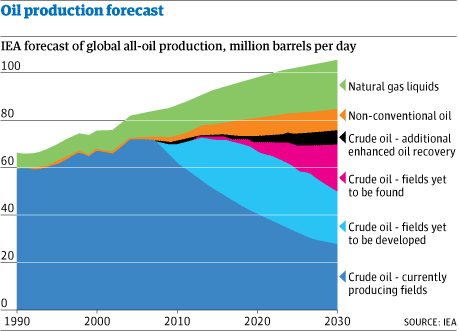
US (=Bush) Pressured IEA to Inflate Oil Reserve Numbers


Did the International Energy Agency inflate oil reserve figures to make it look like we're not facing peak oil?

That's what the Guardian is reporting, based on statements by a whistleblower:
The senior official claims the US has played an influential role in encouraging the watchdog to underplay the rate of decline from existing oil fields while overplaying the chances of finding new reserves.

The allegations raise serious questions about the accuracy of the organisation's latest World Energy Outlook on oil demand and supply to be published tomorrow – which is used by the British and many other governments to help guide their wider energy and climate change policies.

...Now the "peak oil" theory is gaining support at the heart of the global energy establishment. "The IEA in 2005 was predicting oil supplies could rise as high as 120m barrels a day by 2030 although it was forced to reduce this gradually to 116m and then 105m last year," said the IEA source, who was unwilling to be identified for fear of reprisals inside the industry. "The 120m figure always was nonsense but even today's number is much higher than can be justified and the IEA knows this....
Read the whole thing...

Monday, October 12, 2009

Glen Hansard and Damien Rice Busking for Oxfam!

This is fun... and important. It's so great when folks use their star power to bring more people into the green movement...

Tuesday, October 06, 2009

Do it for the Planet.


Coming up on October 15.... sign up and do your part, too!

Coal Is Too Dirty... :)


I didn't realize that some college campuses have their own coal-fired power plants. Time for a change....

Friday, August 14, 2009